

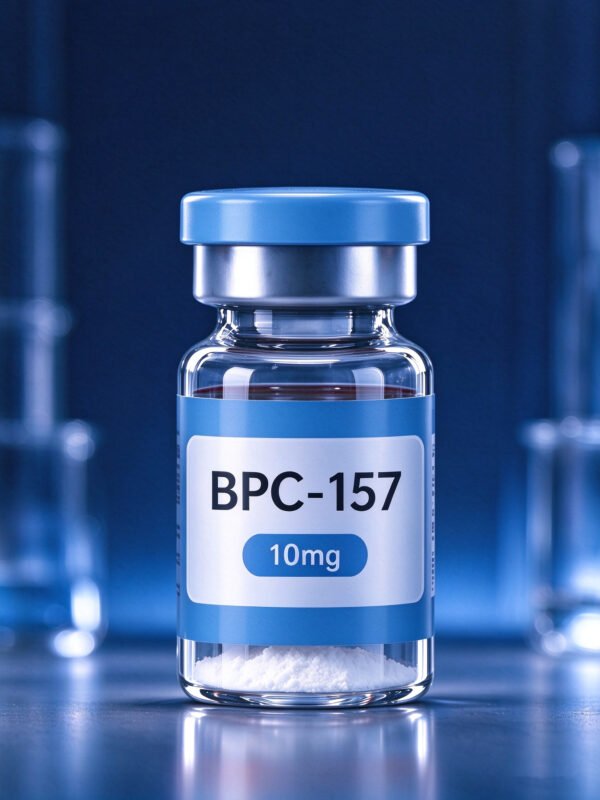
About BPC-157
What Is BPC-157?
BPC-157 (“Body Protection Compound 157”) is a synthetic pentadecapeptide — a 15-amino-acid sequence originally isolated as a fragment of a protein found in gastric juice. It is supplied by ChinaPeptideshop as a research-grade lyophilized powder for in vitro and preclinical research use.
CAS: 137525-51-0. Sequence: Gly-Glu-Pro-Pro-Pro-Gly-Lys-Pro-Ala-Asp-Asp-Ala-Gly-Leu-Val.
What Published Research Has Reported
The statements below are direct attributions to peer-reviewed preclinical studies. They describe observations in animal models or in vitro systems only and should not be interpreted as human clinical claims.
- Sikiric et al. (2014) reviewed the role of the nitric oxide system in rodent BPC-157 studies and reported interactions between the pentadecapeptide and NO-pathway modulators in gastrointestinal and vascular experimental models. Source: Current Pharmaceutical Design, 20(7), 1126–1135. PMID 23755725.
- Chang et al. (2014) reported that, in cultured rat Achilles tendon fibroblasts, BPC-157 exposure was associated with increased growth hormone receptor expression compared to control. Source: Molecules, 19(11), 19066–19077. PMID 25415472.
- Krivic et al. (2008) observed, in a rat Achilles tendon-to-bone transection model, differences in early functional recovery measurements between BPC-157-treated animals and controls. Source: Inflammation Research, 57(5), 205–210. PMID 18594781.
- Staresinic et al. (2006) reported outcome measurements after application of BPC-157 in a rat transected-quadriceps model. Source: Journal of Orthopaedic Research, 24(5), 1109–1117. PMID 16609979.
Research Areas Where BPC-157 Is Studied
- Preclinical models of musculoskeletal tissue response (rodent tendon, ligament, muscle)
- In vitro fibroblast and endothelial cell culture assays
- Experimental gastrointestinal mucosa models in rats and mice
- Nitric-oxide pathway signalling studies in animal tissue
Specifications
| CAS Number | 137525-51-0 |
| Sequence | Gly-Glu-Pro-Pro-Pro-Gly-Lys-Pro-Ala-Asp-Asp-Ala-Gly-Leu-Val |
| Molecular Formula | C62H98N16O22 |
| Molecular Weight | 1419.53 g/mol |
| Purity | ≥98% (class-level specification) |
| Physical Form | Lyophilized (freeze-dried) powder |
| Salt form | Acetate (standard BPC-157, not arginate/PDA) |
| Available Sizes | 2mg, 5mg, 10mg, 20mg |
Storage
Lyophilized: store unopened vials at −20°C. 2–8°C for short-term use.
Reconstituted: 2–8°C, use within 4 weeks. Do not freeze after reconstitution.
Quality Assurance
- Class-level specification ≥99%
Important Notice — For Research Purposes Only
BPC-157 is supplied by ChinaPeptideshop strictly as a laboratory research compound. The findings cited above are taken from preclinical, animal-model, and in vitro studies and are reported here for research context only. They are not medical claims. BPC-157 is supplied for laboratory research and is not for use in humans or animals. For laboratory research purposes only. Not for human consumption.
Reviews
There are no reviews yet.